
I’ve been building marketing strategies for oil and gas companies for over a decade now. Everything from small independent operators in the Permian to midstream giants moving product across multiple states. And I’ll tell you what I’ve learned: most energy companies are doing marketing wrong.
Not because they’re bad at it. Because they’re approaching it the same way they approached it twenty years ago.
Let me show you what works today.
Why Oil & Gas Companies Need a Strategic Marketing Approach
I run into the same issues over and over when I start working with a new energy client.
They’re stuck in budget-first thinking. “We have $50K for marketing this year. What can you do with it?” That’s backwards. You need to know what you’re trying to achieve first, then figure out what it costs.
They’re relying on the same tactics year after year. Trade show booth? Check. Industry directory listing? Check. Maybe a hastily updated website from 2015? Check. Meanwhile, their prospects are online researching solutions, and these companies are invisible.
They’re spreading themselves too thin. Running ads everywhere, posting randomly on social media, attending every conference. No focus. No strategy. Just spending money and hoping something sticks.
From my experience, the companies that win in this industry are the ones who treat marketing like they treat operations with discipline, measurement, and continuous optimization.
That’s exactly what a specialized marketing for oil and gas approach is built to do bring structure, accountability, and results to your marketing efforts.
SWOT Analysis for Energy Companies
Before I touch a single marketing tactic, I need to know what’s actually happening in your business right now.
The Honest Assessment
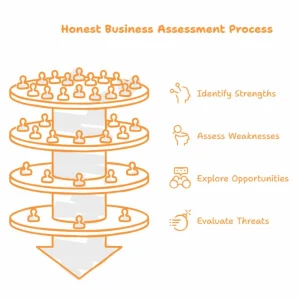
I walk clients through what I call the four-corner analysis. It’s a modified SWOT, but I make it brutally honest.
Your Strengths:
What do you genuinely do better than competitors? I’m not looking for fluff like “great customer service.” I need specifics. Do you complete wells 20% faster? Have zero lost-time incidents over three years? Serve a region no one else covers?
Your Weaknesses:
Where are you genuinely vulnerable? Maybe your website looks like it was built when dial-up was still a thing. Maybe you have no digital presence outside your homepage. Maybe your sales team complains they never get good leads from marketing.
Your Opportunities:
What’s changing in your market that you can capitalize on? New basin opening up? Competitor going through financial troubles? Regulatory shift that favors your approach?
Your Threats:
What keeps you up at night? Price volatility? New environmental regulations? Larger competitors entering your market?
I’ve seen companies skip this step and jump straight into tactics. They waste six months and thousands of dollars before realizing they were solving the wrong problem.
Review Past Marketing Performance
I ask clients to show me everything they’ve done in the past year. Every campaign. Every trade show. Every piece of content.
Then I ask the hard questions:
- Which activities generated actual sales opportunities?
- What did you spend on channels that produced nothing?
- What feedback did your sales team give you?
- What did your best customers tell you about how they found you?
One client I worked with was spending $40K annually on industry directory listings that generated exactly two inquiries in 18 months. Both were tire-kickers who never converted. We killed those listings and redirected the budget to LinkedIn ads targeting specific job titles at target accounts. Generated 23 qualified opportunities in the first quarter.
That’s what honest assessment does.
Define Your Ideal Customer Profile (ICP)
Here’s the biggest mistake I see oil and gas companies make: trying to be everything to everyone.
“We serve all upstream operators.” No, you don’t. Or at least you shouldn’t.
Choose Your Niche
I work with an equipment supplier who thought they needed to target every E&P company in North America. Broad target. Generic messaging. Mediocre results.
We narrowed it down. Permian Basin operators only. Companies running 10-50 rigs. Focused on horizontal drilling. Privately held or backed by private equity.
Suddenly everything got clearer. We knew where these people gathered. We knew what publications they read. We knew what problems kept them up at night. Our messaging got specific. Our content got relevant.
Lead quality went up 300%. Cost per lead dropped by 60%.
That’s the power of focus.
Understanding the Real Decision Makers
In B2B energy sales, I’ve learned that multiple people influence every purchase. Your marketing needs to speak to all of them.
When I map out the buying committee for clients, it usually includes:
Technical Evaluator: Usually an operations manager or chief engineer. They care about specifications, reliability data, and technical performance. They’re reading technical papers and attending engineering conferences.
Financial Gatekeeper: CFO or procurement director. They want to see ROI calculations, total cost of ownership, and payment terms. They’re analyzing spreadsheets and reviewing contracts.
Executive Decision-Maker: CEO or business unit leader. They care about strategic fit, risk mitigation, and long-term partnership value. They’re networking at high-level industry events and reading business publications.
Influencers: Industry consultants, engineering firms, equipment distributors. They recommend solutions based on reputation and relationship. They’re everywhere, and they’re often forgotten in marketing plans.
I create different content for each of these personas. Technical white papers for engineers. ROI calculators for finance folks. Executive briefings for C-suite. Relationship-building programs for influencers.
Most companies create one generic brochure and wonder why it doesn’t resonate.
Setting SMART Marketing Goals
I’ve reviewed hundreds of marketing plans. Most have terrible goals.
“Increase brand awareness.” What does that even mean? How do you measure it? When do you know you’ve achieved it?
I use the SMART framework with every client, but I make it practical.
What Good Goals Look Like
Let me show you real goals from real clients I’ve worked with:
Fuel Marketer Planning Expansion:
- Specific: Generate 500 qualified leads from commercial fleet operators in five target markets within 6 months
- Measurable: Achieve 40% aided brand awareness among transportation companies in those markets (measured by survey)
- Attainable: Rank in top 3 Google results for “commercial fueling [city name]” in all five markets
- Relevant: Grow LinkedIn company page following from 800 to 2,000 with 80% followers from target industries
- Timely: Grow LinkedIn following within 6 months
Drilling Services Company:
- Specific: Create 45 sales-qualified opportunities from target accounts (defined as operators with 5+ active rigs)
- Measurable Reduce average sales cycle from 9 months to 6.5 months through better marketing qualification
- Attainable: Achieve 25% conversion rate from marketing qualified lead to sales accepted lead
- Relevant: Generate $8M in pipeline value with marketing attribution
- Timely: Achieve above goal within 12 month
See the difference? These are specific, measurable, time-bound, and directly tied to business outcomes.
Timeline Conversation
I always have this conversation with new clients: “Based on your current performance and resources, what’s actually achievable?”
If you’re generating 20 leads per quarter now, jumping to 200 next quarter isn’t realistic unless you’re making massive budget and resource investments. But 35 leads? That’s aggressive but doable.
I plan in 90-day sprints for this reason. Three months is enough time to see results but short enough to pivot if something isn’t working.
Differentiation Challenge in a Commodity Market
This is where it gets hard. Oil and gas can feel like a commodity business. How do you differentiate when everyone claims to be “best in class” and “committed to safety”?
I use what I call the Three C’s test with every client.
Finding Your Real Competitive Advantage
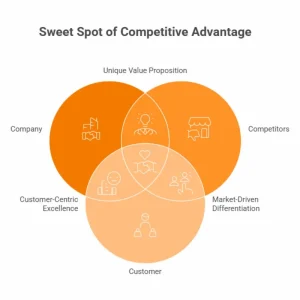
Your differentiation must live at the intersection of:
- Company: What you can actually deliver consistently
- Competitors: What competitors aren’t doing or doing poorly
- Customer: What customers genuinely care about
I worked with a pipeline integrity company that was positioning themselves on “industry-leading technology.” Problem? Three of their competitors used the exact same equipment from the same manufacturers.
We dug deeper. What they were actually great at was predictive analytics using data to prevent failures before they happened. Their team had developed proprietary algorithms that analyzed sensor data in real-time.
The outcome? Their clients had 60% fewer unplanned shutdowns compared to the industry average. That’s a $2-3M annual savings for a typical midstream operator.
We repositioned everything around that outcome: “We predict pipeline failures before they happen, saving our clients millions in downtime and emergency repairs.”
Specific. Provable. Valuable. Different.
Moving from Claims to Proof
I’ve learned that nobody believes your marketing claims anymore. They need evidence.
Instead of “We provide the fastest turnaround times,” I help clients say: “We’ve completed 127 well completions in the last 18 months with an average completion time of 14.2 days 23% faster than basin average.”
Instead of “Our safety program is best in class,” we say: “Zero lost-time incidents across 2.3 million man-hours over three years. Our recordable incident rate of 0.17 is 80% below industry average.”
Instead of “We help operators reduce costs,” we say: “Our clients average $340K in savings per well through our drilling optimization process. Here are five case studies with specific data.”
From my experience, this shift from claims to proof is what separates effective marketing from noise.
Channels That Actually Work for B2B Energy
I get asked all the time: “What marketing channels should we use?”
My answer: the ones where your buyers actually are. Below are some channels
- Google Ads
- LinkedIn for B2B.
- Content Marketing
- Website
- Don’t Forget the Channel Partners
Select High-Impact Marketing Channels and Tactics for more you can check our article 7 Marketing Tactics for Oil and Gas Companies
Budget Allocation: What I Actually Recommend
I don’t believe in percentage-of-revenue budgeting for marketing. I believe in goal-based budgeting. For in detail knowledge you can check How to Build a Marketing Budget for an Oil & Gas Company
Measuring What Actually Matters
I see a lot of marketing reports full of vanity metrics. Impressions. Reach. Engagement rate.
None of that pays the bills.
The Metrics I Track
Early-Stage Metrics (tell me if we’re building awareness):
- Website traffic from target accounts (not total traffic)
- Content downloads by company type
- Webinar registrations from qualified companies
- Social media engagement from target personas (not random followers)
Mid-Stage Metrics (tell me if we’re generating real interest):
- Marketing qualified leads (MQLs) generated
- Cost per MQL by channel
- MQL to sales-qualified lead (SQL) conversion rate
- Sales team feedback on lead quality
Late-Stage Metrics (tell me if we’re driving revenue):
- Pipeline value with marketing attribution
- Marketing-influenced revenue
- Customer acquisition cost
- Average deal size from marketing sources
- Sales cycle length (marketing should shorten this)
Long-Term Metrics (tell me if we’re building value):
- Customer lifetime value
- Win rate on competitive deals
- Customer retention rate
- Referral rate from existing customers
The Dashboard I Build
I create a single-page dashboard that answers these questions:
- Are we generating enough leads? (volume)
- Are they the right leads? (quality)
- Are they turning into opportunities? (conversion)
- Are we winning the deals? (close rate)
- Are we spending efficiently? (ROI)
Updated weekly. Reviewed monthly with leadership. Analyzed quarterly for strategic decisions.
No fluff. Just numbers that matter.
Aligning Marketing with Sales
This is where most B2B marketing dies. Marketing generates leads. Sales says they’re terrible. Marketing gets defensive. Nothing gets better.
I fix this by forcing alignment from day one.
The Agreement I Make Sales Sign
Before I start any marketing program, I get sales leadership to agree on:
Lead Definition: Exactly what constitutes a marketing qualified lead. Usually something like:
- Company matches ICP (size, industry, location)
- Individual has relevant job title
- Demonstrated specific interest (downloaded case study, attended webinar, requested quote)
- Has budget and authority or can introduce us to who does
- Need identified within next 6-12 months
What I’ve Learned After Years of This
I’ve built marketing programs for exploration companies, equipment suppliers, midstream operators, service providers, and fuel marketers. Different segments, but the same fundamental truths apply.
Focus beats scale. Every time. The companies trying to be everything to everyone get mediocre results everywhere. The companies that dominate a specific niche crush it.
Proof beats promises. Nobody believes your claims about quality and service. They believe your case studies with real data from real customers.
Consistency beats brilliance. One brilliant campaign that runs for a month doesn’t move the needle. Steady, consistent execution of good tactics wins over time.
Alignment beats activity. Marketing doing 50 things that don’t support sales goals is worthless. Marketing doing 7 things that directly generate sales opportunities is gold.
Speed beats perfection. I’d rather launch something good today and improve it based on real data than wait three months to launch something “perfect.”
Want to talk through how this would work for your company? I do this for a living. Drop me a note, and let’s figure out what’s holding you back and what would move the needle for your business.